


Copyright © RMB Capital India Private Limited 2026. All rights reserved.
Copyright © RMB Capital India Private Limited 2026. All rights reserved.
LIBOR is an acronym for the London Interbank Offered Rate (LIBOR). It is one of the most widely used interest rate benchmarks in the world. It is published in several currencies on a daily basis. It is the prevailing interest rate that banks use to lend to each other. LIBOR is based on loan rate submissions from participant banks (Panel Banks). Practically, it’s the key pillar supporting an estimated US$350-trillion in financial contracts worldwide.
LIBOR has had a long and influential history. Devised in 1969 as a method to price a syndicated loan deal with the Shah of Iran, LIBOR was later formally published by the British Bankers Association and grew to become an international go-to benchmark.
LIBOR globally underpins US$350-trillion worth of loans and derivatives from variable-rate mortgages to interest-rate swaps. LIBOR has been widely used since the 1980s, and its use has paralleled the explosive growth in global capital markets. Today, it serves as a reference rate for the full spectrum of financial transactions (from adjustable-rate mortgages and home equity loans to business loans and interest rate swaps).
LIBOR and its determination have come under scrutiny from global regulators following the 2008-2009 Global Financial Crisis, due to inherent problems with its construction and misconduct in its determination. In 2017, the UK’s Financial Authority found that traders had colluded to manipulate and rig the (LIBOR) rates to make a profit at clients and counterparts’ expense. This discovery led to numerous reviews and reports by national and international organisations that fully uncovered the scandal in 2012. In 2017, the UK’s Financial Conduct Authority (FCA) announced that they will no longer compel banks to submit rates for the calculation of LIBOR (post-2021). This propelled a global shift away from the use of Interbank Offered Rates (IBORs).
The case for moving away from LIBOR as a reference rate is powerful. The previously experienced LIBOR determination problems made many banks nervous of being involved in LIBOR’s publication reputationally. The interbank lending and borrowing market has become less important since the financial crisis, because new rules encourage banks to use other forms of borrowing. That means there are fewer transactions to base the rate on.
One of the crucial improvements suggested in these reports is that LIBOR submissions should be anchored, to the greatest extent possible, to actual transactions and their associated costs of financing. Despite enhancements to LIBOR, the benchmark isn’t particularly transparent or robust and the rate-setting process hinges on interbank funding transactions that are declining in volume.
Publication of the London Interbank Offered Rate (LIBOR) across various maturity tenors for GBP, EUR, CHF and JPY will likely cease after 2021. USD LIBOR for certain, less frequently used tenor maturities are also anticipated to cease at the end of December 2021. Frequently used and referenced USD LIBOR maturity tenors are anticipated to cease at the end of June 2023. Please refer to the 2021 UK Financial Conduct Authority (FCA) announcement for more details.
The LIBOR transition is a market driven event, not a regulator compelled event. Without the FCA's efforts to secure publication of LIBOR until the end of 2021, we may have already seen panel banks withdraw due to the legal and reputational risk involved. Regulators and central banks aren’t abolishing LIBOR and will not be defining how the LIBOR transition should take place. Instead, they are collaborating with the industry, including trade associations, in mapping a way forward.
Alternative Reference Rates (ARRs) are being developed in key markets to replace current LIBOR currency rates: US dollar, Euro, British pound, Japanese yen and Swiss franc. In the US, the Alternative Reference Rates Committee selected the Secured Overnight Financing Rate (SOFR) as the preferred alternative reference rate to the US dollar LIBOR.
ARRs are structured differently to LIBOR rates, which will mean complexity for impacted companies. For example, the US dollar LIBOR is typically a forward-looking rate with a 1-month or 3-month tenor that implicitly includes bank credit risk. SOFR is a backward-looking overnight rate and, as a repo rate, is secured by collateral.
Working groups from around the world have proposed alternative reference rates or are working to substantially strengthen existing rates. Five reference rates are emerging as an alternative to LIBOR. These alternative rates differ by region, currency, tenor, and basis.
At the fourth ARRC roundtable, panel members estimated that system and computational changes, in light of the large number of parties and stakeholders involved, might require as much as 18 months’ lead time to transition more complex products such as securitisations. As regulators and central banks are not defining how the LIBOR transition should take place, companies will need to determine which alternative benchmark they will use. With regulators issuing few if any hard mandates, financial firms will probably make different operational changes and follow different strategies and timelines.
The transition from LIBOR and other IBORs is expected to impact both existing and future transactions, particularly in derivatives, bonds, structured products, securitised products, loans and mortgages but also in other products and contract types that reference IBORs.
RMB believes that an internationally recognised and sustainable benchmark solution is vital for an efficient financial market. We therefore support the market transition from LIBOR and other IBORs and are actively involved in industry discussions. We are contributing to the industry dialogue with regulators, central banks and industry bodies, aiming to achieve continuity for benchmark-based products, continued financial market resilience and good outcomes for our clients.
We have undertaken an impact study on how LIBOR’s discontinuation will affect our business and clients and are also working through internal steps and processes to balance benchmark transitioning with our obligations. RMB has also set up a LIBOR governance and implementation program and remains focused on identifying and addressing the transition impact to our clients, operational capabilities and financial contracts, among others.
The current planned dates for the transition from GBP, EUR, CHF and JPY LIBOR to the new risk-free reference rates is as follows:
The publication of the following rates are expected to cease after 31 December 2021
And publication of the following USD rates are expected to cease after 30 June 2023:
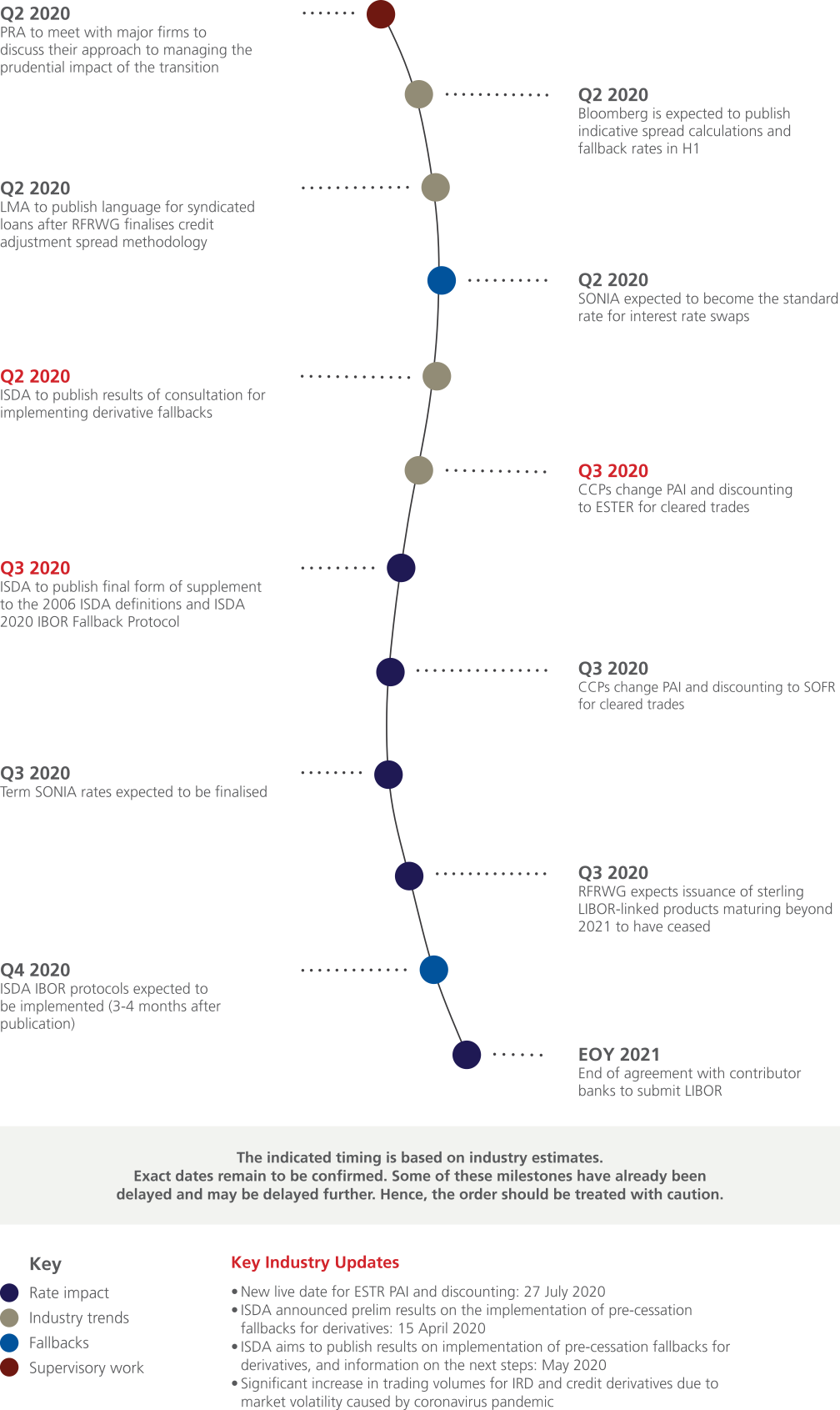
RMB is currently analysing LIBOR-impacted client contracts and assessing amendment provisions contained within these documents. We encourage our clients to undertake a similar analysis and review exercise and to take appropriate independent professional advice (legal, tax, accounting, financial or other) so that they can understand the impact of the discontinuation of any LIBOR on their portfolios with RMB and their business more generally.
This will be determined on a per contract basis and depend on the financial product and the existing fallback language used. Clients should review their documentation carefully and seek independent professional advice (legal, tax, accounting, financial or other) as appropriate when considering whether a transition to an ARR is best achieved by amending the contract, either bilaterally or by participating in a market initiative (for example by adhering to relevant ISDA protocols), or replacing the product with a financial product that references the preferred ARR. The amendment process is likely to be different for each product type and is best discussed with RMB Relationship Managers.
We encourage clients to keep up to date with the latest industry developments in relation to benchmark transitioning (eg. monitoring the announcements of industry working groups and international bodies and the relevant product groups) and to consider the impact on their business, using independent professional advisers (legal, tax, accounting, financial or other) as appropriate.
Please see the Glossary for links to further information in relation to relevant ARR working groups. We encourage our clients to follow the progress of product offerings referencing ARRs and assess whether they may be suitable for them. Clients should consider seeking independent professional advice (legal, tax, accounting, financial or other) as appropriate.
In this context, ‘fallback language’ refers to the legal provisions in a contract that apply if the underlying reference rate in the product (eg. LIBOR) is permanently discontinued or ceases to be available. A fallback will generally consist of two components:
There are a range of market standard fallbacks for different rates as applied to various financial products. Clients should review their documentation closely to determine the position for each contract in their portfolios, in relation to existing or legacy products, as well as for any new products they are considering entering into. Various industry groups have started to provide template fallback language for new products and are working closely with market participants to develop an amendment process for legacy products so that this fallback language can be applied retrospectively. In some cases, amended fallback language will be incorporated with reference to other documentation (for example, with ISDA derivative contracts and the application of ISDA definitions, ISDA supplements would amend the definitions in applicable new transactions entered into from the date of the relevant ISDA supplement (unless otherwise agreed between the parties), while ISDA protocols would amend the definitions retrospectively to apply to existing documentation).
Fallback provisions in the 2006 ISDA Definitions (which are standard terms often incorporated into interest rate derivatives) were drafted primarily for a temporary cessation of an IBOR (eg. many ISDA definitions require quotes to be obtained from certain reference banks if the applicable reference rate is not available). As a result, it is currently difficult to predict what rate would be paid under existing derivative contracts after a permanent cessation of an IBOR referenced by the contract. In this context, and at the request of the FSB’s OSSG, ISDA is undertaking work to implement more robust fallback language for certain IBORs.
As part of this initiative, ISDA intends to update the 2006 ISDA Definitions through one or more fallback supplements (the “ISDA IBOR Fallbacks”) to include fallback language to certain adjusted ARRs that would take effect and provide certainty if key IBORs, including LIBOR, are permanently discontinued.
ISDA also intends to publish one or more protocols (the “IBOR Protocols”), which would allow adhering parties to include the new adjusted ARR fallback language in certain existing derivative contracts with other adhering parties and would amend the 2006 ISDA Definitions and the 2000 ISDA Definitions accordingly. It is currently expected that the first of these ISDA IBOR Fallbacks and IBOR Protocols will become effective at the same time.
RMB has adhered to the new published ISDA IBOR Fallbacks and IBOR Protocols, and intends to (i) incorporate the new ISDA IBOR Fallbacks into our new derivative contracts and (ii) to adhere to the IBOR Protocols and apply IBOR fallback language to existing derivative contracts (in each case when the ISDA IBOR Fallbacks and the IBOR Protocols become available). We encourage clients to familiarise themselves with the new ARR fallback language being developed as part of this process and consider the suitability of the proposed IBOR Protocols in respect of their existing transactions once the IBOR Protocols are available. Clients should consider seeking independent professional advice (legal, tax, accounting, financial or other) as appropriate.
RMB recognises the benefits to clients and the market with regard to a transition from IBORs to ARRs where appropriate. Market participants engaged in this transitioning process will want to create as much liquidity in the ARR market as possible. In this context, RMB is a liquidity provider in new and existing ARRs for derivatives transactions and intends to consider its use of IBORs and ARRs in derivatives and, where appropriate, (i) to follow market initiatives as proposed by ISDA to apply compounded ARR and adjustment spreads to its existing derivatives contracts, (ii) how it can best apply ARRs to new derivatives trades and (iii) any proposed adjustment payments that which could be made following a transition between different rates.
Clients should consider this issue based on their portfolios and whether (i) such portfolio includes cash and derivative products which are both linked to IBOR terms and (ii) there is any mismatch between fallback language applicable for each product. Clients should consider seeking independent professional advice (legal, tax, accounting, financial or other) as appropriate.
RMB is reviewing the industry approach in respect of a range of benchmark rates and financial products and developing its strategy as the market develops in respect of this issue. In relation to legacy derivative contracts, RMB intends to adhere to the IBOR Protocols when they become available.
The ISDA Benchmarks Supplement (the Benchmarks Supplement) was published by ISDA in September 2018 primarily to address certain benchmark requirements under the European Benchmarks Regulation (EU BMR). It allows parties to include, in respect of certain derivative contracts, the actions they would take if a referenced benchmark materially changes or ceases to be provided, including nomination of alternative benchmarks where feasible and appropriate. These actions to be taken, or fallbacks, are provided in the Benchmarks Supplement and can be applied to derivative transactions which reference benchmarks and incorporate one or more of the following definitional booklets (the covered definitional booklets): 2006 ISDA Definitions; 2002 ISDA Equity Derivatives Definitions; 1998 FX and Currency Option Definitions; and 2005 ISDA Commodity Definitions.
Clients who are subject to the benchmark user requirements under the EU BMR should take note that the Benchmarks Supplement is designed to facilitate compliance with these requirements in relation to transactions incorporating the covered definitional booklets.
Incorporating the Benchmarks Supplement may also enable one to apply IOSCO’s recommended practices on use of benchmarks. Please see the Glossary for links to further information in relation to these practices.
The EU BMR is a piece of European legislation passed to ensure the accuracy and integrity of benchmarks produced and used in the EU. It came into force on 30 June 2016, with most provisions applying from 1 January 2018.
One of the aspects of the EU BMR is that it imposes obligations on ‘supervised entities’ that use a benchmark within the EU, including banks, insurers, central counterparties (CCPs), certain pension funds and others. It requires those entities to produce and maintain robust written plans using a fallback language to set out the actions they would take if a referenced benchmark materially changes or ceases to be provided, including nomination of alternative benchmarks where feasible and appropriate. This fallback language must be reflected in the contractual relationship between ‘supervised entities’ and their clients.
The EU BMR also prohibits ‘supervised entities' from using a benchmark in the EU, unless the administrator of the benchmark (or the benchmark itself) is included on a specific register maintained by the European Securities and Markets Authority (ESMA) and provides that fallback language must also apply in certain circumstances where authorisation or approval of a benchmark administrator is withdrawn.
If a withdrawal agreement is agreed between the UK and EU 27 and ratified, and a transition period under the withdrawal agreement is entered into, the expectation is that there should be no impact on the position under the EU BMR during that period (and so UK supervised entities would remain subject to the EU BMR during such period). The position at the end of any such transition period would depend on any political agreement reached and the proposed post-Brexit position in both the EU and UK.
In the event of a ‘no deal’ Brexit, the EU BMR would be retained in UK domestic law with certain amendments (UK BMR). The UK BMR would apply to UK supervised entities and, like the EU BMR, would require those entities to produce and maintain robust written plans setting out the actions they would take if a referenced benchmark materially changes or ceases to be provided. Similar to the EU BMR, the UK BMR would also prohibit UK supervised entities from using a benchmark in the UK, unless the administrator of the benchmark (or the benchmark itself) is included on a specific register maintained by the FCA. There are transitional measures in place to mitigate the immediate effects of moving from the EU BMR to the UK BMR through the creation of a transitional period until the end of 2022 or for whatever period is agreed.
When used in combination with the covered definitional booklets, the Benchmarks Supplement incorporates and applies fallback language if:
These events are also referred to as ‘trigger events’ within the fallback language. The Benchmarks Supplement also contains acknowledgements regarding the consequences of a change to a benchmark. These acknowledgements provide that, following a change to a benchmark, references to that benchmark will be to that benchmark as changed.
Given that some of the covered definitional booklets already contain fallback language which applies upon the occurrence of some of these trigger events, the amendments which would be made by incorporating the Benchmarks Supplement into the terms of a transaction vary from booklet to booklet.
The Benchmarks Supplement can be incorporated into transactions by parties:
The BMS Protocol consists of industry-standard documentation published by ISDA, which market participants can use to (i) incorporate the terms of the Benchmarks Supplement into new transactions, or new and legacy transactions, under existing master agreements and (ii) comply with the EU BMR benchmark user requirements.
RMB is adhering to the BMS Protocol and exchanging questionnaires with counterparties on ISDA Amend, where possible, in order that new transactions with clients under existing master agreements have robust fallback language. As a result of the additional bilateral delivery requirements associated with adhering to the BMS Protocol, ISDA, together with IHS Markit, have developed a technology-based solution on the ISDA Amend platform which allows adhering parties to share submitted data to permissioned counterparties. Alternatively, RMB will agree with clients bilaterally how to apply the Benchmarks Supplement to those transactions.
Please see the Glossary for links to further information in relation to ISDA Amend.
It is not possible to specify that only certain covered definitional booklets will be covered by the terms of the BMS Protocol. This means that as part of the BMS Protocol adherence method RMB also intends to implement the Benchmarks Supplement in its entirety.
Benchmark fallback language provided by these two ISDA workstreams interacts in a number of ways. Some of the key similarities and differences are:
As a result, the Benchmarks Supplement covers a wide range of benchmarks, including IBORs. During the period before the draft ISDA IBOR Fallbacks or IBOR Protocols become effective, parties would still be able to apply interim fallback arrangements to their new IBOR-based transactions using the Benchmarks Supplement.
If ISDA's IBOR fallback language (once available) is incorporated into a transaction alongside the terms of the Benchmarks Supplement, the IBOR fallback language would take precedence in the event that a key IBOR is permanently discontinued or ceases to be available. The generic fallback language in the Benchmarks Supplement will, however, apply if its wider trigger events occur which would not trigger the application of IBOR fallback language.
Read the disclaimer